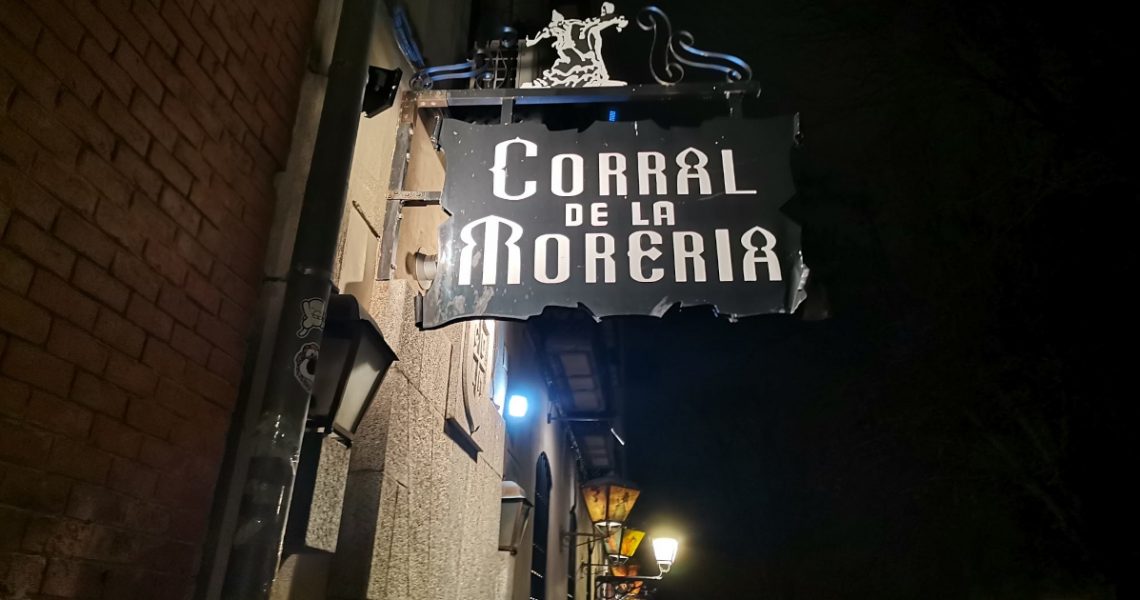
Corral de la Morería Tablao Flamenco Madrid: our night at the world’s most famous tablao
We are back in the wonderful Spanish capital for a week, visiting flamenco shows for our new book Where to See Flamenco: Madrid, due for publication in early 2026. After seeing a show every night of the trip, there was only one way to bring it to a close. Our final evening was spent at Corral de la Morería Tablao Flamenco Madrid, widely regarded as the most famous tablao in the world.
Corral de la Morería: first impressions
If flamenco tablaos had a Mount Olympus, Corral de la Morería would be right at the summit. Artists, aficionados and travellers alike have spoken reverently about Corral de la Morería for decades. “The most famous flamenco tablao in the world” is a phrase often used, and unusually, this does not feel like an exaggeration here.
Walking through the door, the first thing that strikes you is the atmosphere. The room is arranged in an elegant L-shape, with the tabla set neatly into the corner so that everyone feels close to the action. The sala is laid out with around 30 tables, seating roughly 100 people. On the night we visited, most tables were occupied by diners, creating an exciting dinner-and-show atmosphere. The crowd here is elegant and engaged – beautifully dressed, many also look like they really know their flamenco.
The décor is rich and restrained. Paintings line the walls, including a large canvas as a backdrop to the stage that seems to watch over the performers. Candles flickering on the tables, though discreetly electric, add to the sense of intimacy. The waiting staff move smoothly and attentively around the tables, professional and warm, making you feel part of something exceptional, rather than simply a customer. The food is a stunning example of culinary artistry, as befits a Michelin-starred restaurant, the only one of its kind. The tablao and management are charming, and one of the founder’s sons, Armando del Rey, was walking from table to table, making guests feel very special. He devoted a lot of time to us, chatting in English and Spanish, and telling us about the history of Corral de la Morería for our book.
A short history of Corral de la Morería
Corral de la Morería opened its doors in 1956, founded by Manuel del Rey, a member of a prominent Madrilenian family with deep roots in hospitality. His vision was radical for its time. He wanted to create a space where top-level gastronomy and serious flamenco could exist together, each enhancing the other. This was a decisive break from the older cafés cantantes, and it helped redefine what a flamenco night out could be.
The story becomes even richer with the arrival of Blanca del Rey, who first performed here as a teenager. Born in Cordoba, Blanca Ávila Molina was already an exceptional dancer when she came to Madrid and met Manuel del Rey. They later married, and after stepping back from the stage for a time to raise their family and study art history, she returned with an even deeper artistic vision. Today, she is the artistic director of Corral de la Morería, and her influence is felt everywhere. The programming is flawless, demonstrating absolute respect for flamenco tradition while maintaining a quiet confidence in innovation.
The list of artists who have performed here over the decades is a testament to the rich history of flamenco. Pastora Imperio, Antonio Gades, Camarón de la Isla, La Paquera de Jerez and many others have performed on this very stage. It is no surprise that Corral de la Morería has attracted not only flamenco royalty but also international celebrities, from Ava Gardner and Marlene Dietrich to the Rolling Stones and, more recently, Dua Lipa.
The tabla itself deserves a special mention. It is not just a platform but an instrument in its own right, engineered to amplify the dancers’ footwork. Beneath the wooden boards is a carefully designed structure that enhances every golpe and heel strike. The boards are replaced regularly, worn down by the sheer intensity of the dancing. Sitting just a few metres away, you feel every vibration pass through the floor and into your whole being. The stage has its own flamenco duende.
The flamenco show at Corral de la Morería
As the lights dimmed and the show began, the energy in the room shifted. Two singers stood at the back, joined by guitar and cajón, with a male and female dancer taking the stage. The opening was explosive, driven by tight palmas and a powerful rhythmic pulse. This is flamenco performed at the highest level, uncompromising and thrilling.
The female dancer, Claudia La Debla, first appeared in a striking red dress with a ruffled skirt, later changing into a sophisticated black costume with crystal detailing. Her dancing was elegant and regal, at times almost courtly. But it was always based on strong rhythmic accuracy. She carried herself like a queen, commanding the room with quiet authority.
Among male dancers, José Manuel Álvarez stands out with his tall, slim silhouette and superb stagecraft. His movement was full of contrasting footwork, with sharp kicks and drags followed by moments of stillness, triple pirouettes and finely controlled dynamics. The ensemble work was incredibly tight, showing the virtuoso technique and depth of mutual understanding between the artists.
One of the joys of a night like this is the sense that anything can happen. Towards the end of the show, two guests left their table and joined the artists on stage. They turned out to be Ana Morales and Patricia Guerrero, both world-class dancers, who delivered stunning cameo performances in their evening clothes and everyday footwear. Moments like this underline the unique status of Corral de la Morería. It is not just a venue but a living meeting point for the flamenco world.
Is Corral de la Morería worth it?
Of course, food is an essential part of the experience here. Corral de la Morería is a Michelin-starred restaurant, and the quality of the cuisine matches the standard of the performance. This dedication to excellence across every aspect of the evening is central to the Corral de la Morería philosophy. The mindset is simple but demanding: hire the best artists, the best chef and the best waiting staff, and let them do what they do best.
What makes Corral de la Morería truly special is the way all these elements come together. The history, the artistry, the gastronomy and the atmosphere form a complete experience that feels not only grand, but very civilised and deeply human. It is steeped in tradition, yet alive and evolving.
As we stepped back out into the Madrid night, there was a sense of having witnessed something definitive. For anyone serious about flamenco, this is a pilgrimage site. For those just beginning their journey into the art form, it sets a benchmark that few places anywhere can match.
Corral de la Morería is a must-visit if you’re planning a trip to Madrid and want to experience flamenco at its best. Experiences like this are precisely why we are creating our Where to See Flamenco series of flamenco guides and why we continue travelling, watching, listening and writing. Nights like this remind us that flamenco, when done properly, is not just a performance. It is an encounter you carry with you long after the final chord and dance step fade away.
Check out our flamenco guides
Get our ebook: “Where To See Flamenco – Granada”
Choose your local Amazon store:


Get our ebook: “Where To See Flamenco – Costa del Sol”
Choose your local Amazon store:
Where to See Flamenco – Madrid
Coming spring 2026 Our next guide, Where to See Flamenco – Madrid, is on its way.